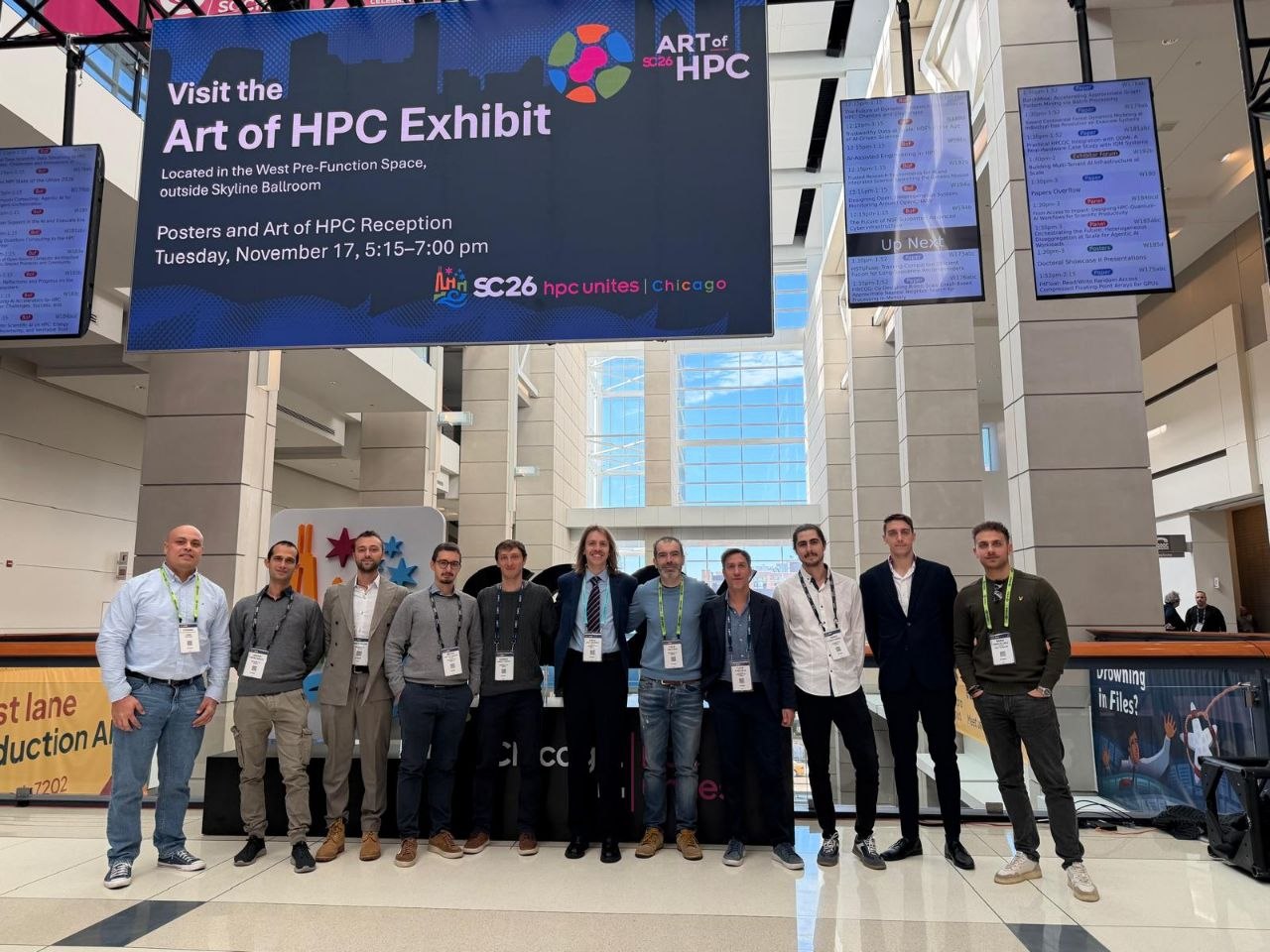
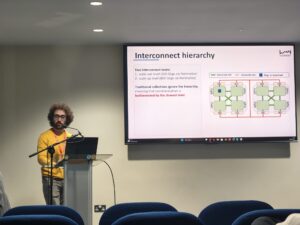
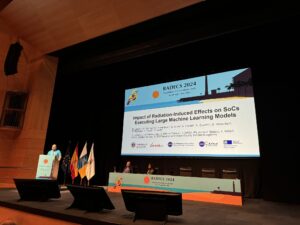
The HiCREST Laboratory recently returned from Chicago after an intense and rewarding week at SC26, the International Conference for High Performance Computing, Networking, Storage, and Analysis. Representing the University of Trento, our team took part in the conference’s main technical program, workshops, and Birds-of-a-Feather (BoF) sessions—contributing new research while engaging with the global supercomputing community.
🔬 HiCREST Contributions at SC26
Throughout the week, our researchers presented four works spanning quantum fault tolerance, hardware reliability, large-scale AI infrastructure, and climate modeling:
- TETRIS-Q: Tiling-Based Effective Transient-Fault Reduction on Interleaved Superconducting Qubits (Main Technical Program)
Authors: Marzio Vallero, Gioele Casagranda, Flavio Vella, Paolo Rech
Addressing radiation-induced correlated errors in superconducting qubits, this work introduces a cross-layer approach combining phonon barriers, quantum error correction (QEC) interleaving, and topology-aware tiling—achieving up to three orders of magnitude reduction in logical error rates without additional execution or decoding overhead. - The Anatomy of a Misprediction: Tracking Terrestrial and Orbital Radiation-Induced Errors in Systolic Arrays (Main Technical Program)
Authors: Pedro Foletto Pimenta, Paolo Rech
An in-depth investigation into how terrestrial and orbital radiation affects systolic array architectures, providing critical insights into hardware fault propagation and reliability for safety-critical and space-bound AI workloads. - Characterizing the Scalability and Performance of Large-Scale AI Training Under Multi-Tenancy (Main Technical Program)
Authors: Jacopo Raffi, Thomas Pasquali, Domenico Siracusa, Flavio Vella (in collaboration with Sapienza Università di Roma, ENEA, NVIDIA, and Forschungszentrum Jülich)
Evaluating distributed AI training across up to 2,400 GPUs on leading supercomputers (Alps, Leonardo, LUMI, and JUPITER), this study explores how concurrent workloads interfere over shared interconnects, informing smarter scheduling and placement strategies for future “AI Factories.” - Toward GPU-Resident Climate Models: A Feasibility Study on Lossy Compression for the Spherical Harmonic Transform’s Communication Bottleneck (Workshop Presentation)
Authors: Lorenzo Breschi, Flavio Vella
Exploring the use of lossy compression techniques to alleviate communication bottlenecks in GPU-resident climate simulations, paving the way for faster and more scalable Earth-system modeling.
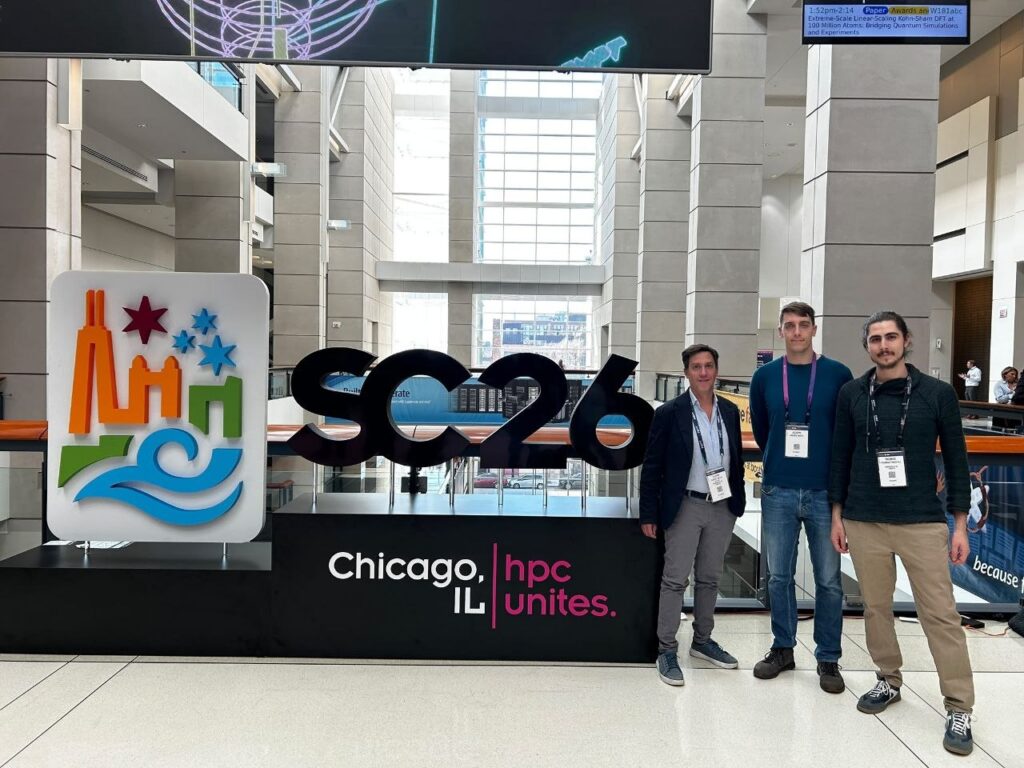
🌐 Key Takeaways and Emerging Trends
Beyond our presentations, SC26 offered a clear snapshot of where High-Performance Computing is heading:
- The AI Wave and Spatial Accelerators: Artificial intelligence dominated both the technical tracks and the exhibition floor, with growing momentum around specialized spatial accelerators and the architectural demands of large-scale AI Factories—while classical HPC algorithmic research continued to demonstrate strong, foundational vitality.
- The Evolution of Collective Communication: As supercomputers increasingly run hybrid scientific simulation and AI workloads, the traditional boundaries between communication models (such as MPI, NCCL/RCCL, and SHMEM) are blurring. Discussions across sessions pointed toward a shift from monolithic libraries to composable communication primitives, GPU-initiated networking, and tighter compute–communication co-optimization.
- Community and Collaboration: Between technical sessions, Birds-of-a-Feather discussions, and evening social events, the conference proved to be an invaluable venue for strengthening international partnerships, exchanging ideas with peers, and sparking new research directions.
We thank all our co-authors, collaborators, and everyone who joined our sessions in Chicago. Follow our updates as we build on these discussions in the months ahead!